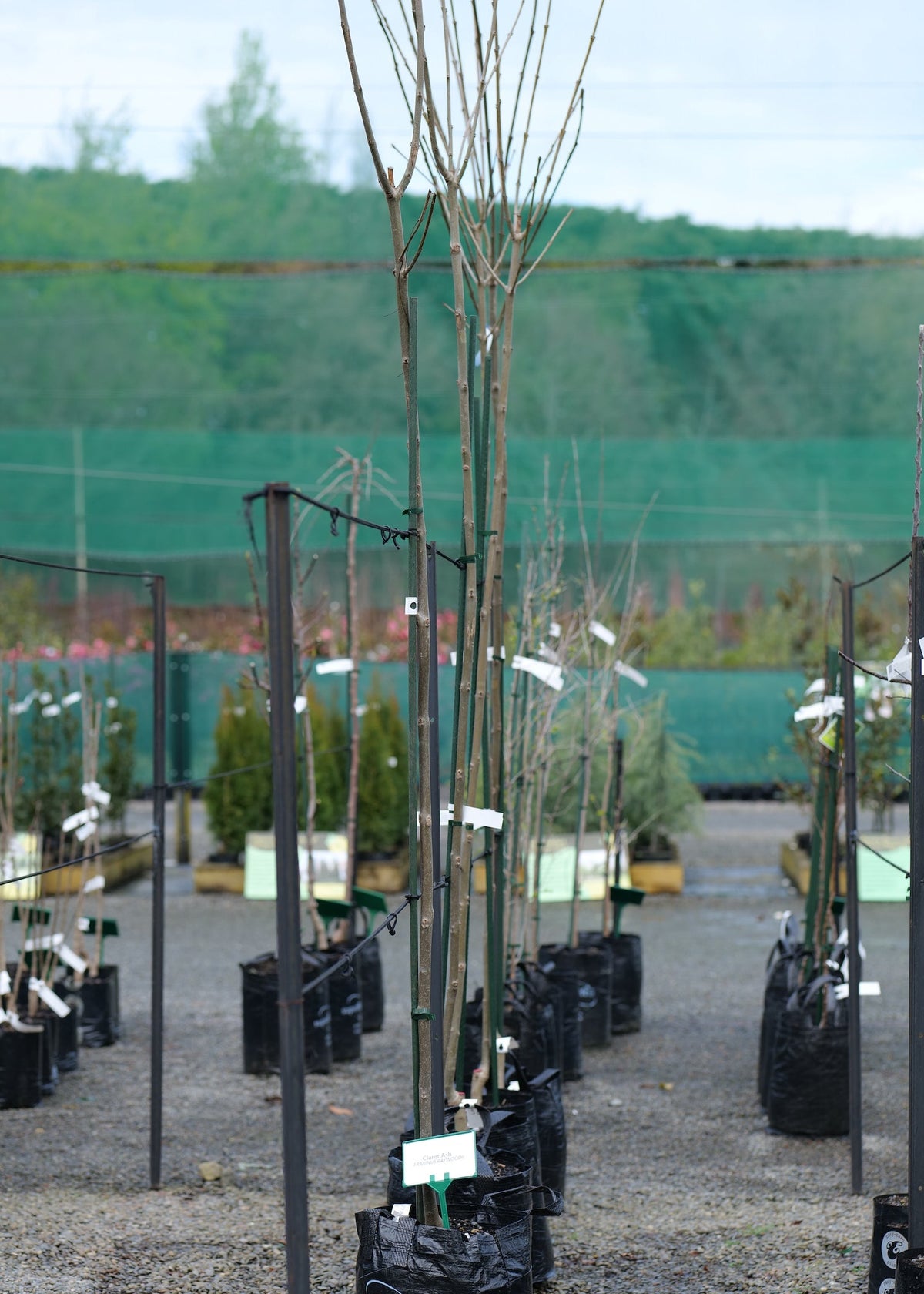
Fraxinus Raywoodi
Fraxinus Raywoodi
Claret Ash, Raywood Ash
Fraxinus angustifolia 'Raywood', commonly known as Claret Ash or Raywood Ash, is a large deciduous tree prized for its attractive rounded canopy and spectacular autumn colour.
Through spring and summer, it carries elegant, narrow leaflets of fresh to deep green, creating a generous leafy canopy and excellent summer shade. Come autumn, things get considerably more interesting. The foliage develops rich shades of burgundy, claret, purple-red and crimson, making Raywood one of the standout large trees for autumn colour.
Hardy, adaptable and capable of developing into a substantial specimen, Claret Ash is particularly well suited to large gardens, lifestyle blocks, driveways, avenues and open lawns.
Just give it some room. It may look fairly innocent sitting in its nursery pot. It won't stay that size.
Why You'll Love Claret Ash
- Spectacular claret-red autumn foliage
- Attractive green spring and summer canopy
- Excellent large shade tree
- Fast to moderate growth
- Hardy and frost tolerant
- Tolerates a range of soil conditions
- Good drought tolerance once established
- Attractive rounded mature canopy
- Excellent specimen tree for lifestyle properties
- Provides summer shade while allowing winter sunlight through
- Expected 5 Year Height 10.0 M Width 6.0 M
Is Fraxinus Raywoodi suitable for my garden?
Is Fraxinus Raywoodi suitable for my garden?
Fraxinus Raywoodi is best suited in a position that gets
- Full sun
Fraxinus Raywoodi is
- Deciduous
- Fast-growing
- Cold hardy
- Frost Tolerant
Fraxinus Raywoodi will thrive in soil that is
How to establish your Fraxinus Raywoodi?
How to establish your Fraxinus Raywoodi?
Plant Claret Ash in full sun.
Choose the position based on the eventual size of the tree, allowing plenty of room for both its canopy and root system to develop.
Consider:
Distance from buildings
Overhead powerlines
Underground services
Driveways and paving
Neighbouring properties
Other large trees
In an open lawn or lifestyle block, give it the room to develop its natural canopy rather than planting it somewhere you'll spend the next 20 years trying to make it smaller.
How to maintain your Fraxinus Raywoodi once established?
How to maintain your Fraxinus Raywoodi once established?
Water deeply and regularly during the first couple of growing seasons.
This is particularly important during Canterbury's hot, dry summers and periods of persistent nor'west winds.
Deep watering encourages the root system to establish into the surrounding soil.
Once established, Claret Ash develops good tolerance of dry conditions, although occasional deep watering during prolonged drought can still be beneficial.
Avoid frequent shallow watering, which encourages roots to remain close to the surface.
Apply a generous layer of organic mulch around young trees.
Mulching helps:
Retain soil moisture
Reduce grass and weed competition
Moderate soil temperature
Improve soil structure
Encourage faster establishment
For young trees planted into lawns, maintaining a generous grass-free area around the trunk can make a surprisingly big difference.
Keep mulch slightly away from direct contact with the trunk.
Claret Ash generally doesn't require heavy feeding once established.
For young trees, apply a balanced slow-release fertiliser in spring if required.
An annual layer of compost around the root zone can also help improve soil fertility and structure.
Avoid excessive nitrogen fertiliser, which can encourage overly soft, vigorous growth.
Formative Pruning
Young trees can benefit from some careful formative pruning to establish a strong framework.
Prune to:
Maintain a strong central leader
Remove competing leaders where necessary
Remove crossing or rubbing branches
Remove damaged growth
Develop well-spaced structural branches
Good formative pruning while the tree is young is considerably easier than trying to correct structural problems once the branches are the size of your leg.
Once established, routine pruning should be minimal.
Remove dead, damaged or structurally problematic branches where required.
Large-tree pruning is best undertaken by a suitably qualified arborist.
Newly planted Claret Ash trees may require staking, particularly in exposed Canterbury sites.
If staking:
Use flexible ties.
Allow some natural trunk movement.
Check ties regularly.
Loosen them as the trunk expands.
Remove stakes once the root system can support the tree.
Leaving a tree permanently tied to a stake isn't helping it develop a strong trunk.
Claret Ash is highly frost hardy and well suited to cold, temperate areas of New Zealand.
After producing its autumn display, the tree loses its foliage and becomes dormant through winter.
Established specimens require very little winter care.
Newly planted trees will benefit from mulch around the root zone and continued watering whenever extended dry conditions occur.
Once established, Claret Ash can cope with reasonably exposed conditions, although young trees benefit from protection while developing their root systems.
In Canterbury, persistent nor'west winds can rapidly dry the soil around newly planted trees.
Regular deep watering and a generous mulch layer will help considerably during establishment.
Couldn't load pickup availability
Share