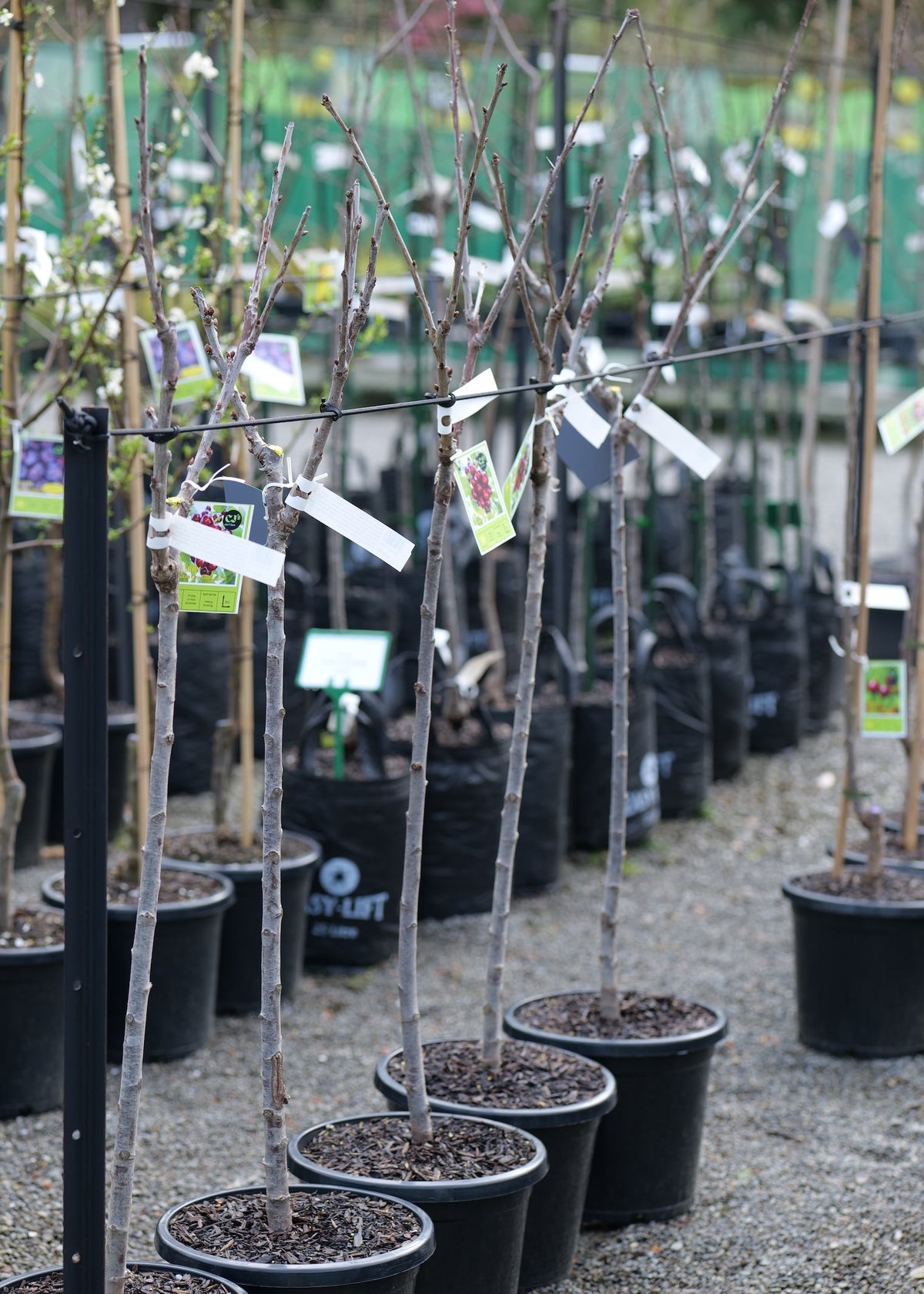
Cherry - Double Dawson\Lapin
Cherry - Double Dawson\Lapin
Double Grafted Cherry
Double Worked Cherry 'Dawson / Lapins' combines two popular sweet cherry varieties grafted onto a single tree, giving you both Dawson and Lapins from one root system.
It's a clever option for smaller gardens and home orchards where you'd like more than one cherry variety but don't necessarily have room for multiple full-sized trees. The combination also gives you two slightly different cherries to harvest.
Dawson is a classic dark cherry with large, sweet, richly flavoured fruit, while Lapins produces large, firm, dark red cherries and has the added advantage of being self-fertile.
Beautiful white spring blossom followed by proper summer cherries.
There's quite a lot going on for one tree.
Why You'll Love Double Worked Dawson / Lapins
- Two cherry varieties on one tree
- Excellent space-saving option
- Includes Dawson and Lapins
- Large, sweet cherries
- Dark red fruit
- Lapins is self-fertile
- Two varieties can help extend the harvest
- Attractive white spring blossom
- Hardy deciduous fruit tree
- Excellent for home orchards
- Well suited to cool, temperate New Zealand climates
- Great option for gardeners with limited space
- Expected 5 Year Height 3.0 M Width 3.0 M
Is Cherry - Double Dawson\Lapin suitable for my garden?
Is Cherry - Double Dawson\Lapin suitable for my garden?
Cherry - Double Dawson\Lapin is best suited in a position that gets
- Full sun
Cherry - Double Dawson\Lapin is
- Self-fertile
- Wind Tolerant
- Frost Tolerant
- Deciduous
- Edible
- Flowering
- Attracts pollinators
- Cold hardy
Cherry - Double Dawson\Lapin will thrive in soil that is
- Free draining
- Nutrient rich
How to establish your Cherry - Double Dawson\Lapin?
How to establish your Cherry - Double Dawson\Lapin?
Plant your Dawson / Lapins Cherry in full sun.
Good sunlight is essential for:
Strong flowering
Fruit development
Ripening
Fruit sweetness
Healthy growth
Aim for at least six hours of direct sunlight each day, preferably more.
Choose a reasonably open position with good airflow but some protection from Canterbury's strongest winds.
How to maintain your Cherry - Double Dawson\Lapin once established?
How to maintain your Cherry - Double Dawson\Lapin once established?
Plant your Dawson / Lapins Cherry in full sun.
Good sunlight is essential for:
Strong flowering
Fruit development
Ripening
Fruit sweetness
Healthy growth
Aim for at least six hours of direct sunlight each day, preferably more.
Choose a reasonably open position with good airflow but some protection from Canterbury's strongest winds.
Soil Requirements
Sweet cherries perform best in fertile, free-draining soil.
Aim for soil that is:
Fertile
Rich in organic matter
Moisture retentive
Free draining
Not permanently saturated
Good drainage is particularly important.
If you're planting into heavier Canterbury soil, improve the planting area where necessary and avoid locations where water sits around the roots for extended periods.
Newly Planted Trees
Water deeply and regularly during the first couple of growing seasons.
Deep watering encourages the root system to establish into the surrounding soil.
Established Trees
Once established, water during prolonged dry periods.
Consistent moisture is particularly important during:
Flowering
Fruit set
Fruit development
Hot summer weather
Avoid repeatedly allowing the tree to become severely dry and then saturating it.
Apply organic mulch around the root zone to:
Retain moisture
Reduce weed competition
Moderate soil temperatures
Improve soil structure
Protect the root zone
Keep mulch slightly away from the trunk.
Mulching is particularly useful through Canterbury's hot, dry summers and nor'west conditions.
Feed in spring with a balanced fertiliser suitable for fruit trees.
Compost or well-rotted organic matter can also be applied around the root zone.
Avoid excessive nitrogen.
Lots of soft green growth may look impressive, but the reason we're growing this particular tree is hanging on the branches and hopefully turning dark red.
Pruning a Double-Worked Cherry
This is where double-worked trees require slightly more attention than a standard single-variety fruit tree.
You need to maintain a reasonable balance between the Dawson and Lapins grafts.
One variety may naturally grow more vigorously than the other.
If one side is allowed to completely dominate, the weaker variety can eventually become shaded or crowded.
When pruning:
Identify which branches belong to each variety
Maintain both grafted varieties
Remove dead or damaged wood
Remove crossing branches
Improve airflow
Control excessive vigorous growth
Maintain an open, balanced framework
Prevent one variety from completely dominating the canopy
If one graft is noticeably more vigorous, prune that section a little harder while allowing the weaker variety more room to develop.
Never accidentally prune an entire variety off the tree.
That rather defeats the point.
When to Prune
Where possible, carry out significant cherry pruning during dry summer weather or shortly after harvest.
Avoid unnecessary large pruning cuts during cold, wet winter conditions.
Regular light pruning is preferable to allowing the tree to become enormous and then attempting major corrective pruning later.
Watch for Growth Below the Grafts
Remove any vigorous shoots emerging from the rootstock below the graft unions.
These shoots aren't Dawson or Lapins and can compete with the fruiting varieties if allowed to develop.
Remove them cleanly when they appear.
Sweet cherries are cold-hardy deciduous fruit trees and benefit from winter dormancy.
Canterbury's cold winters generally suit them well.
The more vulnerable period is spring, when flower buds begin opening.
Late frost can damage:
Open blossom
Developing fruit
Tender new growth
If your garden has obvious frost pockets, plant on slightly higher ground where cold air can drain away if possible.
There is one small issue with growing delicious cherries.
You aren't the only creature who knows they're delicious.
Birds can strip a cherry crop remarkably quickly as the fruit approaches maturity.
Bird netting is one of the most effective forms of protection.
Keep netting securely fitted and taut so wildlife cannot become tangled or trapped.
Maintaining the tree at a manageable height through pruning makes netting considerably easier.
Sweet cherries can sometimes split when heavy rainfall occurs close to harvest, particularly after a period of dry weather.
The fruit rapidly absorbs moisture and the skin can crack.
Maintaining reasonably consistent soil moisture during fruit development can help reduce extreme fluctuations.
If you've got ripe cherries and several days of heavy summer rain are forecast, we'd be inclined to start picking.
Pests and Diseases
Maintain good airflow and garden hygiene around your cherry tree.
Keep an eye out for common problems including:
Aphids
Scale insects
Caterpillars
Bacterial diseases
Fungal diseases during prolonged wet conditions
Remove damaged or diseased material promptly and avoid unnecessary damage to the trunk and branches.
Couldn't load pickup availability
Share